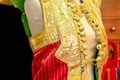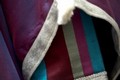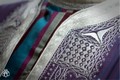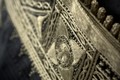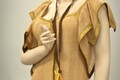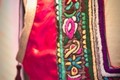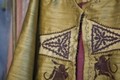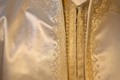


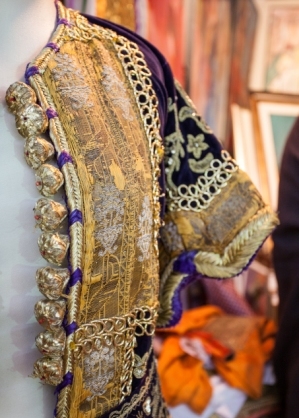
If today, Tunisian dress and adorn themselves in the same way, it was different at the beginning of the century, where each region or every village had its male and female costumes.
Traditional female costume
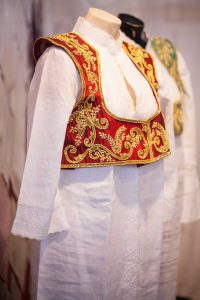
The traditional female costume is characterized by its variety from one region to another. However, the essential part that constitutes the tunic is “cut and sewn”. Designed in large simple tunics forms are often sleeveless, cut into fabrics of wool, cotton or silk, depending on the circumstances. Embroidery is the hallmark of the different regional costumes.
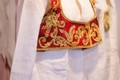
Silver wire, glitter and gold purls are the Ornaments of almost all women’s clothing: shirts (Qmajja) vest (Farmla) dress (Jebba and Kadrûn) scarf (Takrita), Bonnet (Qoufiya) Sleeve (Kmâm) and tunic wedding (large Qmajja).
In the Sahel, rich drapes are manufactured, embroidered with gold and silk where multiple figurative motifs abound: people, flowers, animals… Village women in the mountains of the South enhance their elegant draped dresses with geometric patterns. Caps richly decorated with silk embroidery, silver, pearls and gold jewelry, varied blouses with wide sleeves in lace, embroidery footwear were indispensable complements of these female costumes.
Traditional male costume
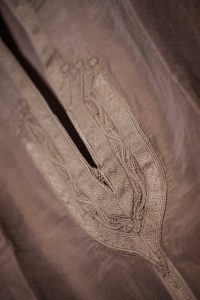
It has its regional specificities while referring to Arab ancestry for its general appearance (full costume). The Kaddroun, the blouse, the bden are still worn especially in rural areas, but this is the Jebba which has become traditional national dress.
The Tunisian Jebba benefited from Andalusian and Turkish influences to make it such it is nowadays.
This ample coat covering the whole body differs depending on the quality of the fabric, its colors and trimmings. Dress fittings (harj-elkessoua), trimmings, braids woven braids must be in harmony with the tissues of the jebba which vary according to the season: wool, silk, linen (melf), linen (quamraya) and mixture of silk and wool (mqârdech).
Parts completing the wearing of jebba, traditional male costume of city dwellers, has two to three open or closed vests (bedaia) sedria, fermla), a jacket (Mentan), a baggy trousers (seroual) cinched at the waist by a wide belt of silk. Outside, this costume is completed by wearing a bathrobe which is also enhanced by a special work of embroiderers men called “Bransia.”
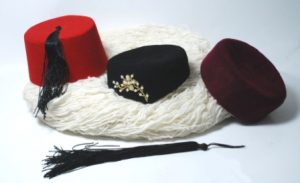
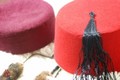
Chechia
This red wool cap with tassel or without tassel, is introduced in Tunisia by skilled Andalusian artisans
from Spain, to become the symbol of our country and which we strive to carry on the tradition and to ensure continuity with multiple incentives established by the State.
Refined and urban crafts, exclusive specialty of master craftsmen of Tunis or “Chaouachiyas” who were part of the aristocracy of the souks and the amine of the profession was appointed from among the notables. Manufacturing involves several phases for more than ten people with various tools and accessories.
Today, chechia, beyond the passion it experienced, is highly popular amongst young people who rediscover it and give it a second wind.
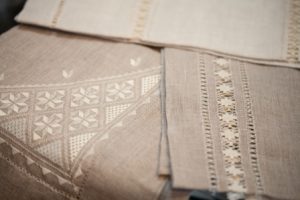
Embroidery
More than any other traditional expression, embroidery expresses an admirable degree of refinement and delicacy reached by Tunisia and its ability to achieve with happiness the realization of the most complex structures.
Embroidery is a true “Naqsh hadida”… The embroiderer is an architect of the thread…His work is a scholarly construction reflecting the civilizational wealth inhabiting the hand holding the needle and guides the thread, link by link, through the tissue in the history.
When the Tunisian woman was still at home, she did not remain idle. she has invested from hes home, in all businesses, playing a vital socio-economic role. Armed with her “Gorgâf”, a circular loom frame, she told embroidered beautiful stories.
Urban and rural men and women in Tunisia have demonstrated the dexterity with which they handle the needle and thread …Variety of genres and styles is perplexing …Such a difference between Raf-Raf embroidery and El Jem or of Kerkena or Moknine …In such a small area of embroidery,
we discover with pride and amazement the considerable wealth of Tunisia.
Embroidery is a diverse writing space with clothing, Tablecloths, pillows, sheets and bedspreads…Embroidery tells, with a full write poetry, the extraordinary unity of the many faces of Tunisia.
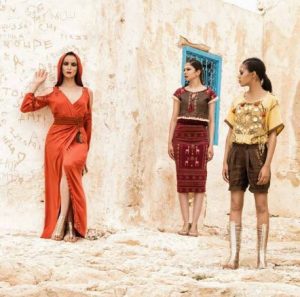 Traditional dress … Creations and tendencies of tomorrow
Traditional Tunisian costume is the receptacle of a cultural heritage always saved, constantly enriched. It is one area in which artistic creation is manifested with more vigor.
This innovative stream which gives rise to a line of Tunisian Costumes was initiated by ONAT by establishing the “Khomsa d’Or” competition in 1996, giving rise each year to a flurry of creativity (creation of a holding functional city, meeting the requirements of modern life to attend everyday concerns, inspired by traditional Tunisian dress). The craze for this new line of male and female Costumes raises hopes and generates skills.